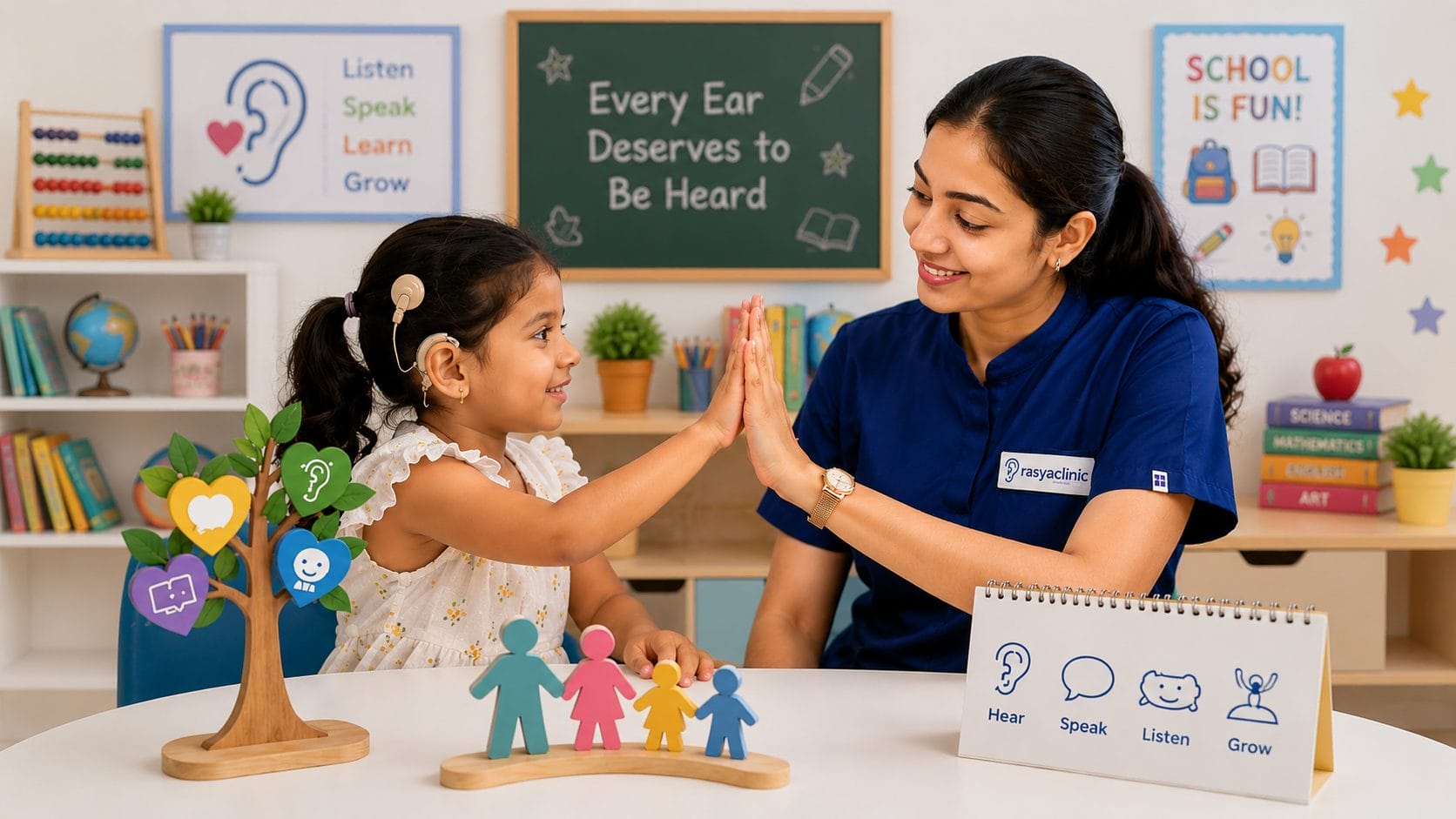
Audiological Precision
Clinical audiologists follow US University Protocols for precise Diagnosis before surgery and for post surgery eABR, NRT, impedance measurement, and ongoing device mapping — ensuring every electrode is optimally tuned.

Welcome to the RASYA Cochlear Implant Program, where we believe restoring a child's hearing is a lifelong journey, not a one-day event. Guided by American clinical protocols, we provide an all-inclusive, team-driven approach to help your child transition from silence to a mainstream school environment.

US University Cochlear Implant Protocol
To guarantee the best outcomes during a child's "Golden Period" (birth to 3 years) — the window when the brain is most receptive to auditory development — we follow a strict 7-step international protocol.
Everything begins with precision. A wrong diagnosis leads to wrong treatment — and a child pays the price. We use four objective, advanced tests to build a complete auditory profile before any treatment decision:
Wideband Tympanometry — evaluates middle ear function with far greater accuracy than conventional tympanometry, especially critical in infants whose ear canals are still developing.
OAE (Otoacoustic Emissions) — checks whether the outer hair cells of the cochlea are functioning. If they produce no emissions, it confirms inner ear involvement.
Advanced BERA (ABR) — measures the brainstem’s electrical response to sound at precise frequency and intensity levels. This is the gold standard for infant hearing assessment.
ASSR (Auditory Steady-State Response) — provides frequency-specific hearing thresholds, giving us an audiogram-equivalent for children too young to respond behaviourally.
These aren’t optional add-ons. All four tests must be completed, confirmed, and cross-verified — because a hearing aid prescribed on a rushed or incomplete test can waste the Golden Period entirely.
Parent takeaway: If your child’s diagnosis was based on a single test done in 30 minutes — get a second opinion. Precision at this stage determines everything that follows.
This is the step most parents never hear about — and it may be the most important.
When a child cannot hear, the brain doesn’t simply wait. The auditory cortex — the part of the brain meant for processing sound — begins to get “taken over” by other senses like vision and touch. This process is called cortical remapping (or what our team calls “brain kabja”).
Once remapping happens, even a perfectly placed cochlear implant delivers diminished results because the brain has reassigned its hearing real estate.
Golden Period: The first three years of life are crucial — this is when the brain has maximum plasticity and auditory pathways are most receptive to stimulation.
Pre-Surgery Hearing: Even before implant surgery (especially during waiting periods for insurance, government schemes, or logistics), children are immediately fitted with low-cost hearing aids and begin structured stimulation therapy.
Primary Goal: The purpose is not to achieve perfect hearing through the aids, but to keep the auditory nerve alive and the hearing centers active.
Parent takeaway: Every week of silence is a week the brain moves on. Even a basic hearing aid with therapy during the waiting period can protect your child’s outcomes.
Not all implants are the same, and not every child needs the same solution.
A cochlear implant system has two parts: an external processor (worn behind or off the ear, which captures and processes sound) and an internal implant (surgically placed under the skin, with an electrode array inserted into the cochlea that directly stimulates the auditory nerve).
We guide parents through choosing the right configuration:
Traditional BTE (Behind-the-Ear) processors — robust, widely used, suitable for most children.
Off-the-ear processors — lighter, more discreet, ideal for active children or those who prefer minimal visibility.
Bilateral implants — for children with profound loss in both ears, enabling true stereo hearing and sound localization.
Hybrid solutions — combining acoustic amplification for residual low-frequency hearing with electrical stimulation for high frequencies.
We work exclusively with FDA-approved, MRI-compatible, upgradeable devices from global leaders — Cochlear, MED-EL, and Advanced Bionics — ensuring your child’s implant is future-proof as technology advances.
Parent takeaway: The right device depends on your child’s anatomy, degree of loss, and lifestyle. We match the technology to the child — never the other way around.
This is the step that causes the most fear — and understandably so. But here’s what every parent needs to know: cochlear implant surgery involves the inner ear, not the brain.
The procedure, performed under general anaesthesia, follows a precise sequence:
A small incision is made behind the ear.
The mastoid bone is carefully drilled to create a pathway — this bone is hollow and spongy; no brain tissue is involved.
The internal receiver-stimulator is secured on the skull surface, under the skin.
The electrode array is gently threaded into the cochlea through the round window.
Intraoperative testing confirms the device is functioning and the electrodes are positioned correctly.
The surgery typically takes 1.5 to 3 hours. The implant is FDA-approved, biocompatible, and MRI-compatible. Children usually go home the next day.
We partner with India’s top ENT implant surgeons — whose precision in electrode placement and soft-surgery techniques maximizes hearing preservation and minimizes risk.
Parent takeaway: This is one of the safest surgeries in modern medicine. The device sits under the skin, the electrode sits in the cochlea — the brain is never touched.
This is where RASYA fundamentally differs from most centres in India.
After surgery, the implant must be “tuned” — a process called mapping. Mapping sets the electrical current levels for each electrode so the child hears sounds at the right volume and clarity. Get mapping wrong, and the child hears distorted, uncomfortable, or incomplete sound — no matter how perfect the surgery was.
The problem with conventional mapping:
Most centres rely on impedance testing (checks if electrodes are working — tells you nothing about hearing quality) and NRT (Neural Response Telemetry) (measures nerve response at the cochlea level — but the cochlea isn’t where hearing “happens”). These are starting points, not endpoints.
Our approach — eABR (Electrical Auditory Brainstem Response):
eABR measures the brain’s actual response to the electrical signals from the implant. It traces the signal all the way from the cochlea through the auditory nerve to the brainstem — giving us an objective, precise picture of what the child is truly receiving.
This is especially critical for infants and non-verbal children who cannot tell you “that’s too loud” or “I can’t hear that frequency.” With eABR, we don’t guess — we measure.
Parent takeaway: Ask any centre one question — “Do you use eABR for mapping?” If the answer is no, the mapping is based on estimation, not measurement.
Surgery gives the ear a signal. Mapping tunes that signal. But therapy teaches the brain what the signal means.
When a cochlear implant is first activated, the child hears electronic signals — not natural sound. The brain’s hearing centre must learn to interpret these new patterns and, over time, connect them to speech and language. This is the work of AVT.
RASYA’s AVT program follows a structured 3-stage framework:
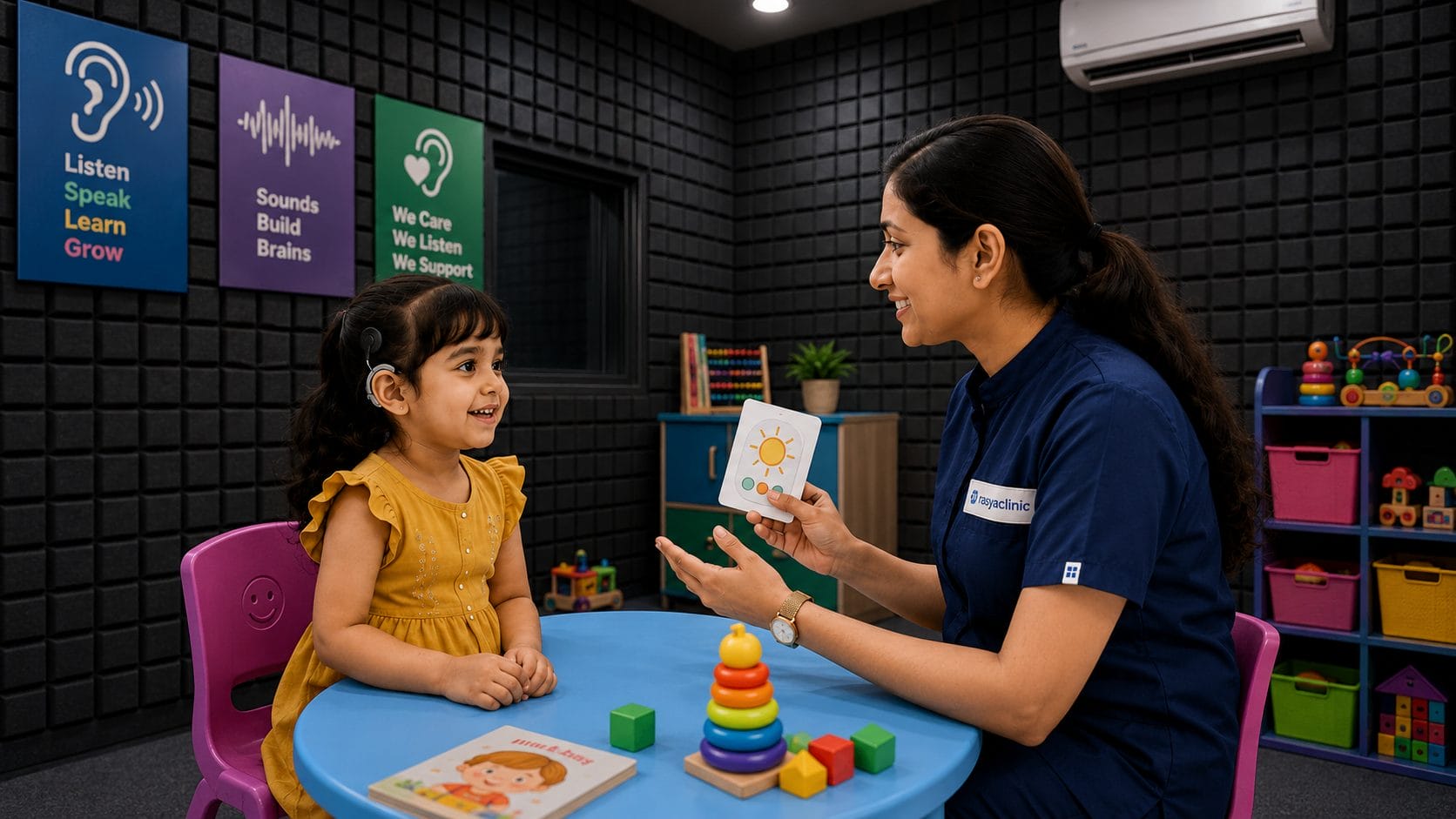
Stage 1 — Sound-Treated Room: Training begins in a completely soundproof environment. The child learns to detect, discriminate, and identify sounds without any distraction. This builds the foundational auditory pathways.
Stage 2 — Semi Sound-Treated Setup: Mild, controlled background noise is introduced. The child learns to filter relevant sound from noise — a skill essential for real-world listening.
Stage 3 — Real-World Training: Therapy moves into natural environments — markets, parks, family gatherings. The child practises listening and speaking in the conditions they’ll face every day.
Each stage is milestone-driven. The child advances only when specific auditory and speech benchmarks are met.
Parent takeaway: AVT is not optional. Without structured therapy, a cochlear implant is an expensive hearing aid that the brain never fully learns to use.
Here’s what most clinics miss: a child who can hear and speak in a quiet therapy room may still struggle in a noisy, fast-paced classroom.
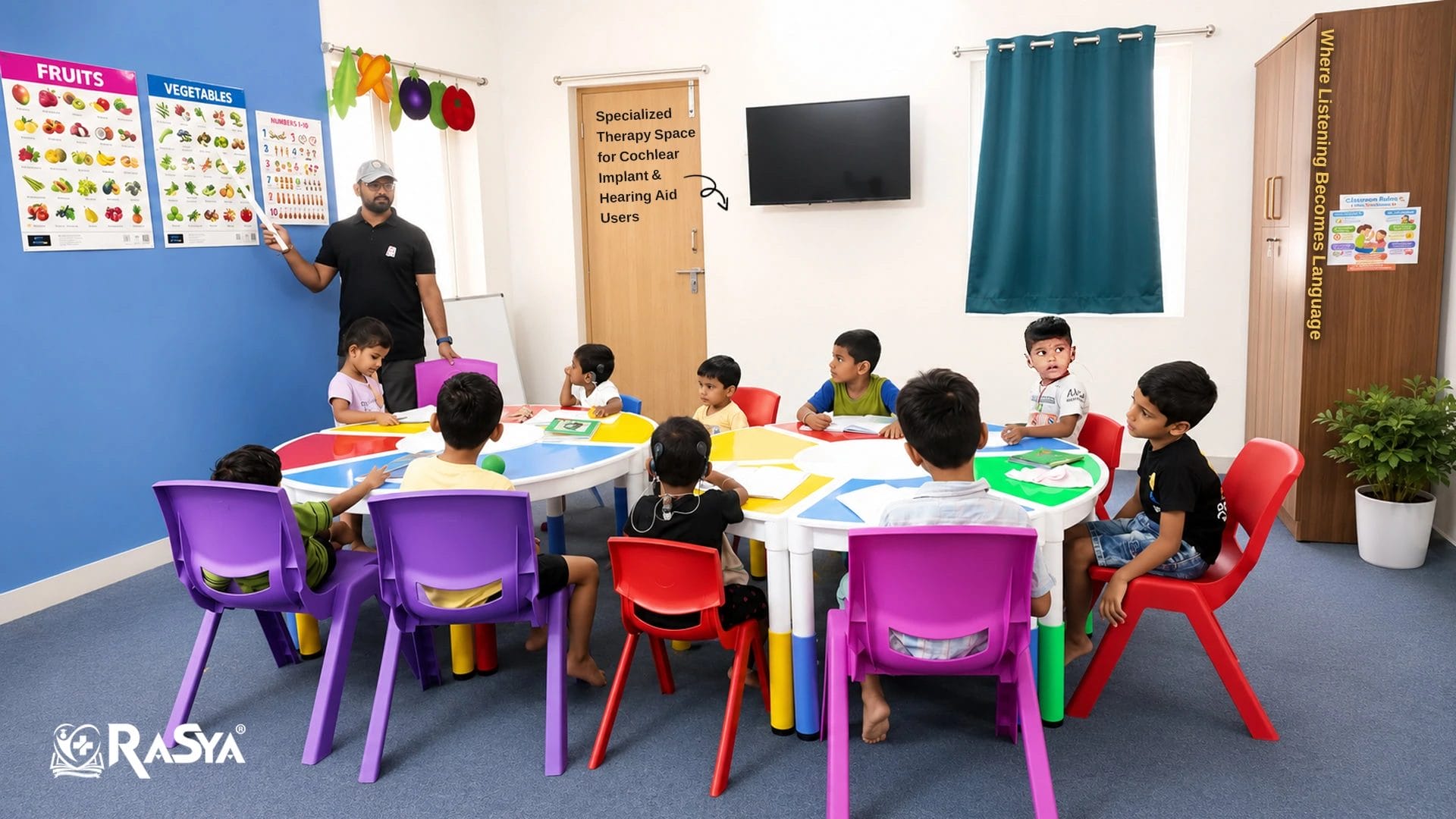
RASYA’s exclusive School Readiness Program bridges the gap between clinical success and real-world success. It focuses on four critical pillars:
Pillar 1. Sitting Tolerance — Building the sustained focus and attention span required for classroom learning. A child who has spent years in short therapy sessions needs deliberate training to sit, listen, and engage for extended periods.
Pillar 2. Listening in Noise — The average classroom has 15–30 children talking, chairs scraping, fans humming. We train the brain to isolate the teacher’s voice from competing noise — a skill that doesn’t develop automatically.
Pillar 3. Social Skills — Peer interaction, turn-taking, sharing, reading social cues, and building communication confidence. These are not secondary skills; they determine whether a child thrives or withdraws.
Pillar 4. Academics & Confidence — Foundational literacy, numeracy, and cognitive readiness tools so the child enters school prepared — not playing catch-up. We build confidence alongside competence.
Children who undergo early implantation (before age 2–3) and complete AVT plus SRP integrate into mainstream regular schools — not special schools. That is our benchmark of success.
Parent takeaway: The goal was never just hearing. The goal is a child who sits in a regular classroom, raises their hand, answers questions, makes friends, and forgets they ever had a hearing problem.
RASYA's strength lies in its team-based approach. No single specialist can deliver the full protocol alone. Our team includes ENT cochlear implant surgeons, paediatric audiologists, AVT-certified speech therapists, child psychologists, and school-readiness counsellors — all working under a unified protocol.
Clinical audiologists follow US University Protocols for precise Diagnosis before surgery and for post surgery eABR, NRT, impedance measurement, and ongoing device mapping — ensuring every electrode is optimally tuned.


Our Team includes experienced ENT surgeons specialising in minimally invasive cochlear implantation with intraoperative verification and nerve-preservation techniques.

AVT therapists guide children through three structured listening stages, while school-readiness counsellors prepare them for academic and social life.


Dedicated counsellors help families navigate emotional, financial, and logistical aspects — from government scheme applications to long-term planning.
All International Cochlear Implants
Your child deserves the most advanced, reliable, and future-proof technology available. We work exclusively with the world's three leading FDA-approved cochlear implant manufacturers:

Industry pioneer, extensive electrode portfolio, strong global support
High-resolution sound processing, waterproof options, integrated connectivity
Longest electrode arrays for full cochlear coverage, excellent MRI compatibility.
Every month of delay reduces your child's potential. Take the first step today — our team is ready to guide you through the entire journey.